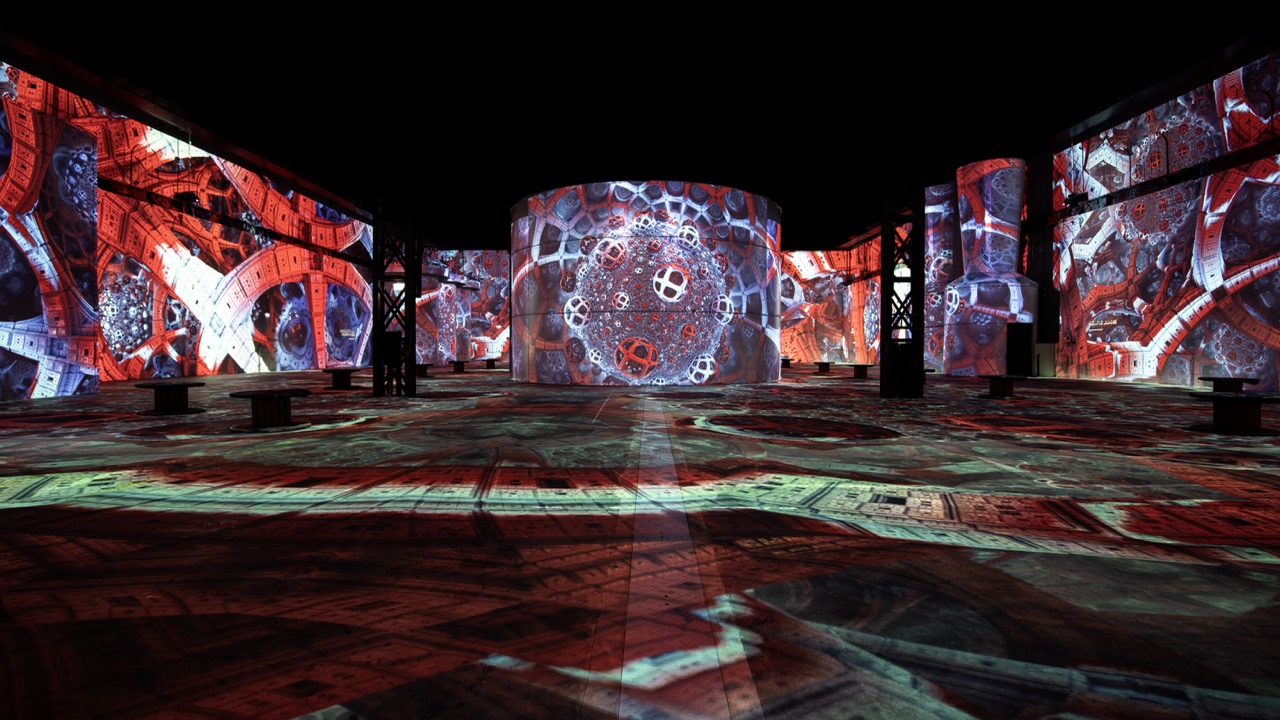
Matera will host THE SEA IS CLOSER THAN YOU SEE, a widespread group exhibition dedicated to the relationship between contemporary art, digital technologies, artificial intelligence and Mediterranean culture.
The project is promoted by the Matera Basilicata 2019 Foundation and the Municipality of Matera, with the support of the Ministry of Culture as part of the programme for Matera, Mediterranean Capital of Culture and Dialogue 2026. The exhibition is organised in collaboration with the National Museums of Matera, the Basilicata Regional Promotion Agency, and the MUSMA and TAM museums. The initiative has also received institutional patronage from the Embassy of the Republic of Cyprus and the Embassy of the Republic of Latvia.
The critical inquiry stems from a seemingly simple question: “how far can the sea be from a place that belongs so deeply to the Mediterranean?”. It takes as its starting point one of the founding statements of the TERRE IMMERSE Dossier: “direct access to the sea is not a prerequisite for belonging to the Mediterranean”. Mediterranean identity, in fact, cannot be defined solely by geographical proximity to the coast. The Mediterranean is also a network of relationships, exchanges, migrations, memories, economies, cultures and transformations that extends deep into the hinterland.
Matera, a city in the Lucanian hinterland, is no exception to Mediterranean geography. Its geological structure preserves the memory of an ancient marine presence: the calcarenite of the Sassi tells of seabeds that have emerged, whilst cisterns, collection systems and underground spaces bear witness to a millennia-long relationship with water. The sea, seemingly distant, is thus inscribed in the very fabric of the city.
It is precisely this merely apparent distance that forms the conceptual heart of THE SEA IS CLOSER THAN YOU SEE. The title does not refer to a sea to be reached, but to a sea that is already present: invisible yet active, embedded in stone, in images, in memories, in bodies, in human journeys and, today, also in data flows and algorithmic systems.
The works by Studio Azzurro, Andrea Crespi, Martin Romeo, Valentinaki, Leonardo Avezzano with Valentin Ammann, Baris Gencel, Giuseppe La Spada, Silvio Giordano and Julius Horsthuis establish a dialogue between different practices: video installation, photography, holography, sound installation, generative art, artificial intelligence, computer vision and immersive environments.
The exhibition interprets the four core themes of TERRE IMMERSE – Stratifications, Isolations, Contaminations and Transhumance – as four distinct ways of interpreting the contemporary Mediterranean: a territory of geological and cultural sedimentation, a space of relationship between centre and periphery, a place of encounter and hybridisation, and a theatre of mobility, migration and the circulation of people, languages and knowledge.