Amalia Del Ponte. Lithoponie is an exhibition project dedicated to the artistic research of Amalia Del Ponte (Milan, 1936–2025), an artist whose work throughout the second half of the twentieth century explored the relationships between sculpture, matter, space and sound.
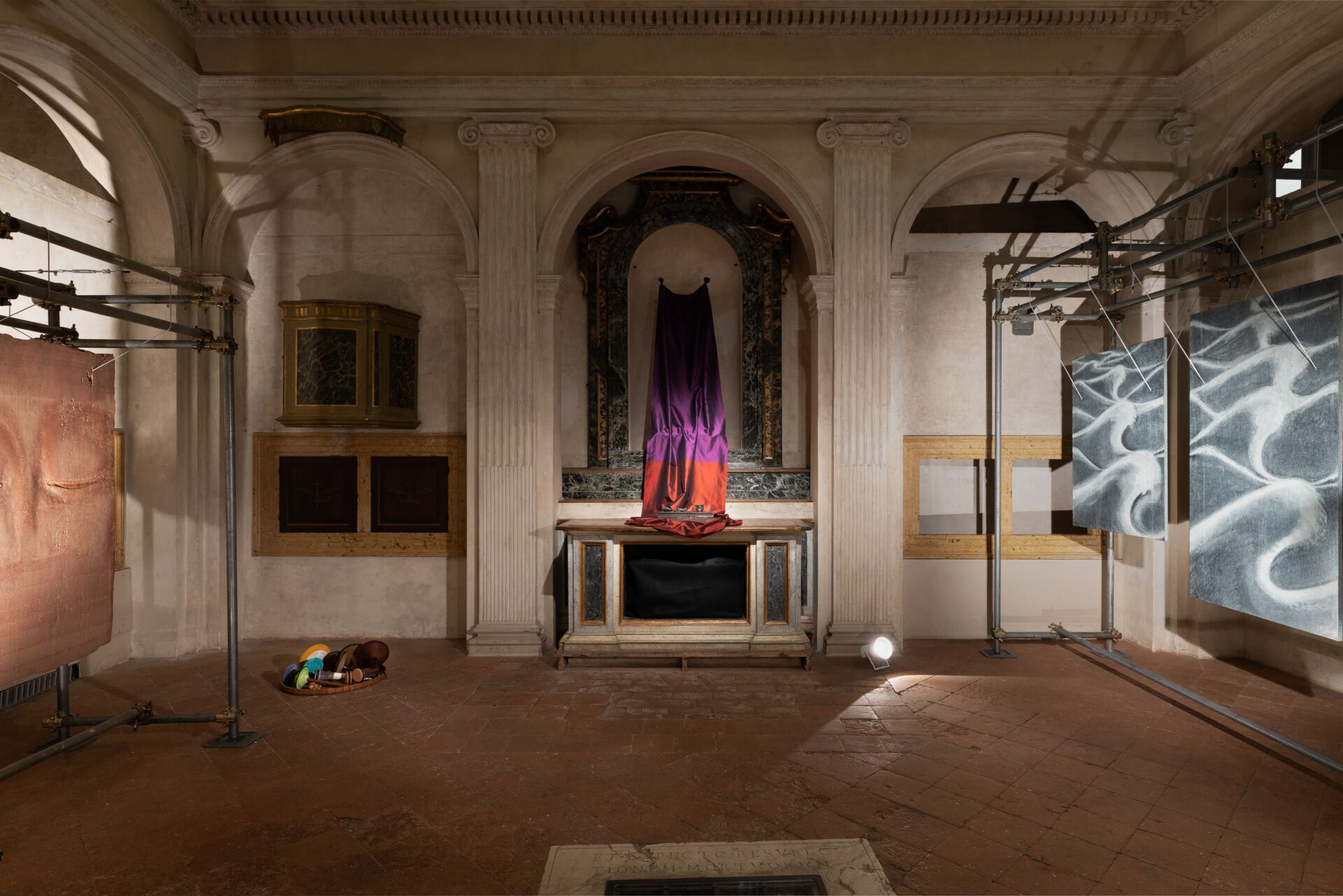
Curated by Marcella Cattaneo, Nicol Longoni Del Ponte and Roberto Pini, the exhibition pays tribute to a sculptor with whom Fondazione Piero Cattaneo shared an important path of collaboration and research over the years. One year after her death, the exhibition, realized in collaboration with the Amalia Del Ponte Archive and Fondazione Adriano Bernareggi, brings together at the evocative Oratorio di San Lupo in Bergamo a significant group of lithophones: works in which stone transcends its purely visual dimension to become sound-producing matter and a space to be experienced through the body and through listening.
The exhibition presents works created between the 1980s and 1990s: Last Minute Bag (1981), Potnia (1989), Acqua nell’acqua (1993) and Musica in gocce (1995). Particularly significant is the presence of Musica in gocce, composed of 28 circular elements in Turkish green marble, which is being presented to the public for the first time since 1995, when it was exhibited in Amalia Del Ponte’s solo room at the 46th Venice Biennale. On that occasion, the four slabs of Acqua nell’acqua were also exhibited in the same room. The Bergamo exhibition therefore brings these two works together again for the first time in over thirty years, reuniting the nucleus presented by the artist in Venice in 1995.
The exhibition highlights the central role of a practice in which sculpture becomes a perceptual experience: stone is suspended, struck and placed in relation to water and space, generating vibrations and sounds. “Do not look at sculpture from the outside, but enter into the sculpture,” Del Ponte stated, suggesting a mode of experiencing art based on the viewer’s direct physical and perceptual involvement.
In dialogue with the architecture of the Oratorio di San Lupo, the works create an environment of listening and participation, restoring to sculpture its sonic and interdisciplinary dimension.