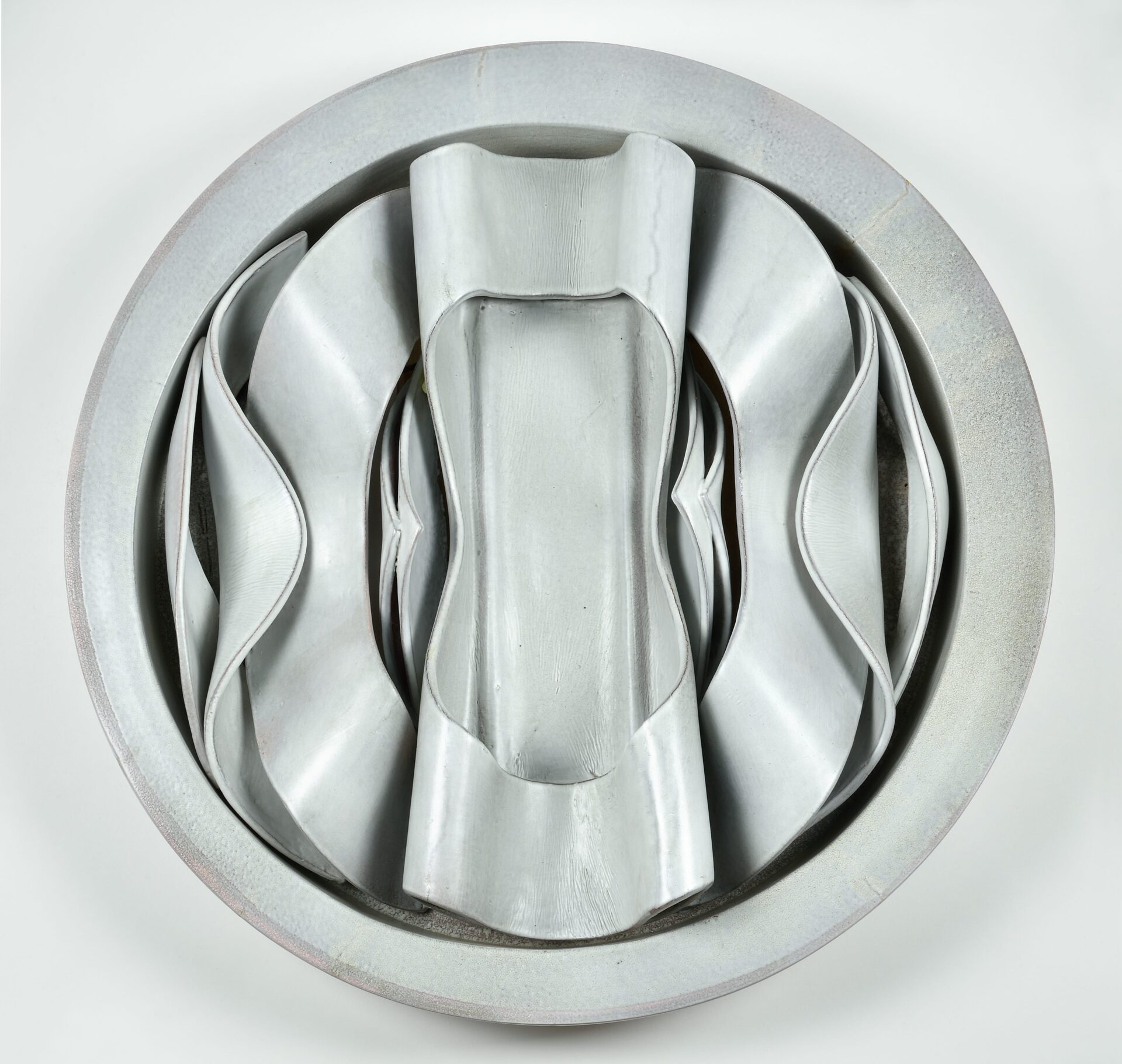
To mark the centenary of the birth of Muky—the artistic name of Vanda Berasi (1926–2022)—a solo exhibition is being held from October 10 in the Project Room of the MIC Faenza, showcasing a selection of significant works from her artistic career spanning the 1950s to the early 2000s.
An artist and poet, Muky dedicated her life to art and the promotion of the arts, developing an artistic practice deeply rooted in ceramics—a medium that accompanied her throughout her creative journey. She honed her craft in Rome, where she connected with artists associated with Villa Massimo, particularly Leoncillo and Massimo Mazzacurati.
Her work from the 1950s is characterized by a predominantly *Informel* and gestural style that emphasizes the material’s plastic qualities. She created large coil-built vessel-sculptures, high-reliefs, and ceramic forms in which the use of achromatic tones and metallic hues highlights the expressive power of the surface.
In the 1960s, her work evolved toward more rigorous, essential, and controlled forms, aligning with minimalist trends. Her gestural approach gradually gave way to a focus on pure form and surface exploration, often utilizing white and refined tonal variations. This period saw the creation of works such as plates of various shapes and ovoid vessels in satin-finish zinc white, which are now held in the collections of the MIC Faenza. Over the following decades, Muky progressively expanded her color palette: moving from an initial preference for achromatic tones and metallic hues to more intense, vibrant colors, to which she often assigned a specific symbolic function. Ceramics thus became a space for continuous experimentation involving form, material, color, and meaning.
Alongside her sculptural work, Muky pursued artistic exploration in painting and a unique form of visual poetry where words and materials converge. She inscribed texts, verses, aphorisms, and dedications directly onto the raw white glaze, transforming the ceramic surface into a space for writing and creating works that fused poetic expression with sculptural form.
From the 1980s and 1990s onwards, her work took on an increasingly symbolic and conceptual dimension. A significant example is the *Presepi contro* (Counter-Nativity Scenes) series, created between 1989 and 2004: these were mixed-media assemblages in which clay-modeled elements engaged in a dialogue with real-world objects and short poetic texts. The works addressed universal themes such as violence, war, consumerism, the human condition, and the longing for peace.
Throughout the 2000s, Muky continued to work with ceramics using an approach based on assemblage and synthesis—one in which forms, materials, and colors took on symbolic and conceptual significance, moving toward an ethical and spiritual dimension.