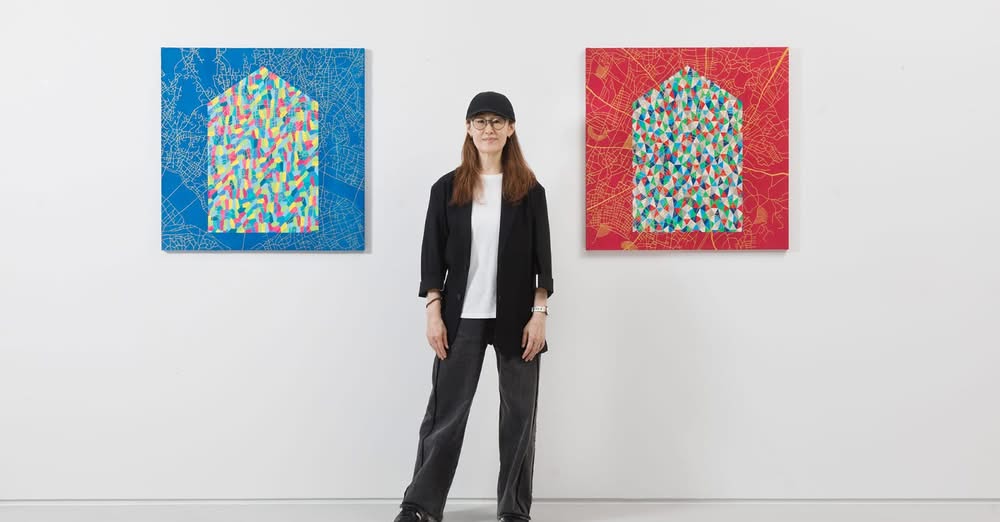
Emotion Code is the first solo exhibition in Italy by South Korean artist Yuni Lee, curated by Angelo Moretti as part of Koinè – Festival dei linguaggi contemporanei (Festival of Contemporary Languages).
The curator will guide visitors through the artist’s vision, which perceives the city as an organic entity in constant transformation, shaped by the accumulation of memory, emotion, time, and relationships.
In Yuni Lee’s affective maps, urban space ceases to be a mere geometric grid, revealing itself instead as a living, pulsating organism shaped by the accumulation of emotional flows. In her works, this complex layering takes shape through a precise visual code: a drawn pattern — a linear network visualizing actual streets, paths, and trajectories — extends across the background. Grafted onto, superimposed upon, and accumulating over this grid is a series of colored cells, each representing the smallest unit holding the memory and emotion of a single individual.
“This superimposition of the drawn skeleton and the grafted, vibrant cells – states Angelo Moretti – resembles that of an oriental carpet, where the warp represents the grid and the weft the decoration that conveys color and emotion. Much like Italo Calvino, the artist to whom she bears the closest affinity, Yuni Lee sees the city as something that is never defined solely by its physical and architectural dimensions; rather, it exists as an invisible accumulation of relationships, time, and human emotions. Just as the Italian writer’s Città invisibili (Invisible cities) are made not of concrete, brick, or stone, but of desires and memories, Yuni Lee’s painting eschews the literal representation of geographical space in favor of decoding its innermost structure”.
A Seoul-based Korean visual artist, Yuni Lee trained in Painting at Hongik University (Seoul) and Fine Arts at Sangmyung University (Seoul). In her Emotion Code project, she translates emotions gathered from places dear to her into color, line, density, and rhythm. While her practice centers on painting, it also extends to video, installation, and digital media. Her works explore how individual emotions transform the city and are, in turn, transformed by it.
“On the surface of the works – says Yuni Lee – I repeatedly layer materials such as acrylic, stone gel, binder, and wax pastels. The texture and tactile relief created by this accumulation of material, combined with layers of transparent and opaque color, reveal the density of time and emotion accumulated within the city.”
The artist has held solo exhibitions in Korea and participated in group exhibitions across Asia, Europe, and the USA.