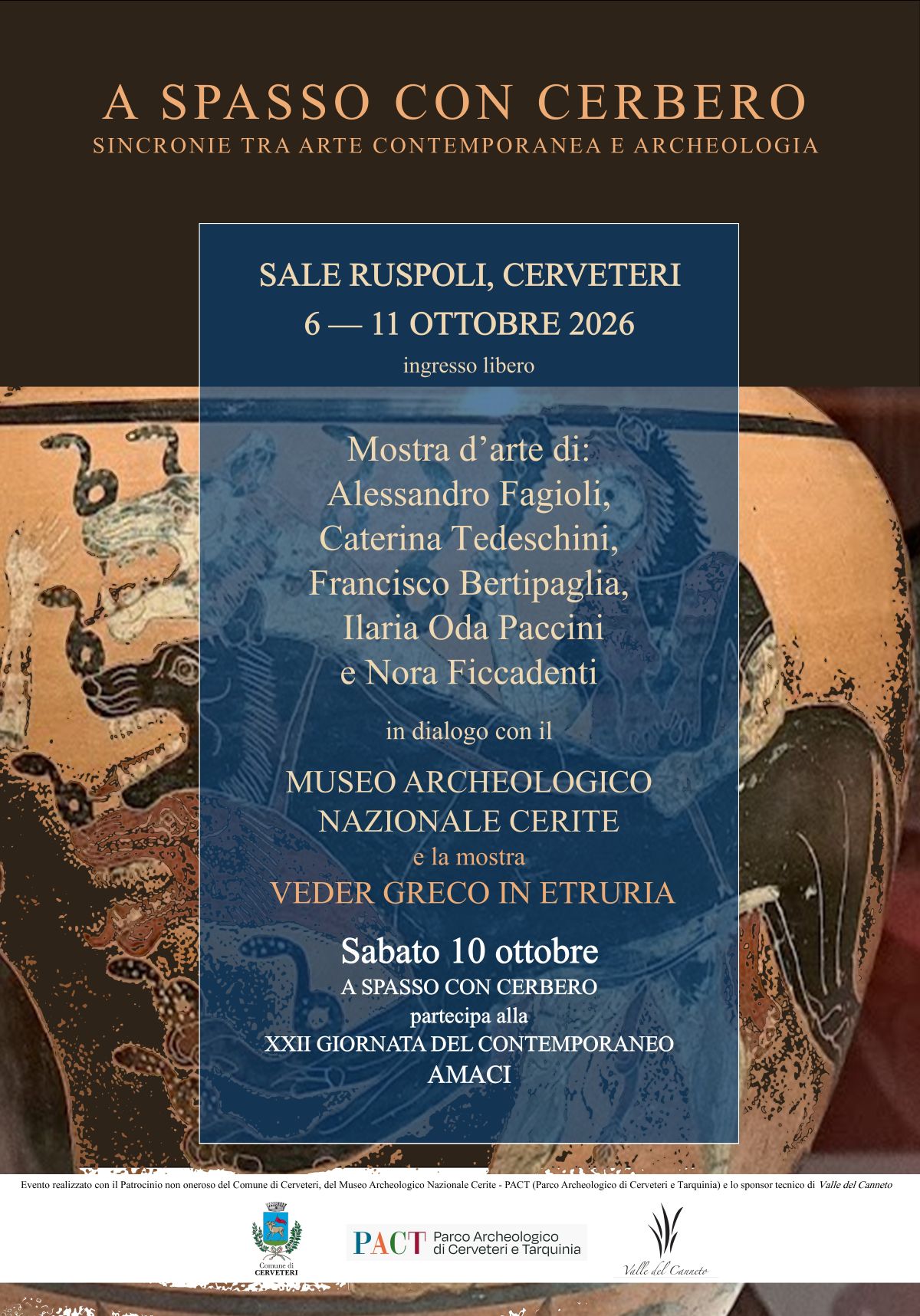
Two generations of contemporary art professionals engage with and draw inspiration from the exceptional collection of vases currently on display in the exhibition “VEDER GRECO in ETRURIA” (Seeing Greek in Etruria) at the National Archaeological Museum of Cerveteri. The Caeretan hydriae—narrative-decorated vases from the 6th century BC, likely crafted by Greek artists who had settled in the territory of Caere—deeply influenced Etruscan civilization; today, they enter into a dialogue with the contemporary visions of five artists: Alessandro Fagioli, Caterina Tedeschini, Francisco Bertipaglia, Ilaria Oda Paccini, and Nora Ficcadenti.
Cerberus serves as the symbol for both exhibitions: guardian of the Underworld and keeper of the order of time (his three heads watch over the past, present, and future), as well as the overseer of the *limen*—the impassable boundary between these three temporal planes and the physical threshold between life and death.
Few heroes manage to cross the boundary leading to the Underworld guarded by Cerberus; among them is Heracles (or Hercules), who did so during his twelfth labor. In ancient times, Heracles was the deity invoked to protect waterways and the boundaries crossed during transhumance—routes where, then as now, “relationships, conflicts, exchanges, and processes of constant redefinition” took shape.
Let us posit that water sources should be a common good and a safe haven for all: are they not, perhaps, the very places where everyone is called upon—and compelled—to welcome others?
And what is the law, if not the imposition—and self-imposition—of limits designed to protect each and every one of us? Every day and everywhere, we witness the slaughter of our fellow beings and other living species in the name of exclusive ownership of a patch of land; these ancient rules thus appear like a distant light: water—an increasingly precious resource—becomes the tangible and urgent symbol of global peace.
In a world that disregards social norms, Cerberus—guardian of the threshold between life and death—can be likened to the female body (itself a guardian of birth/past, life/present, and death/future), which is increasingly violated, just like the natural environment.