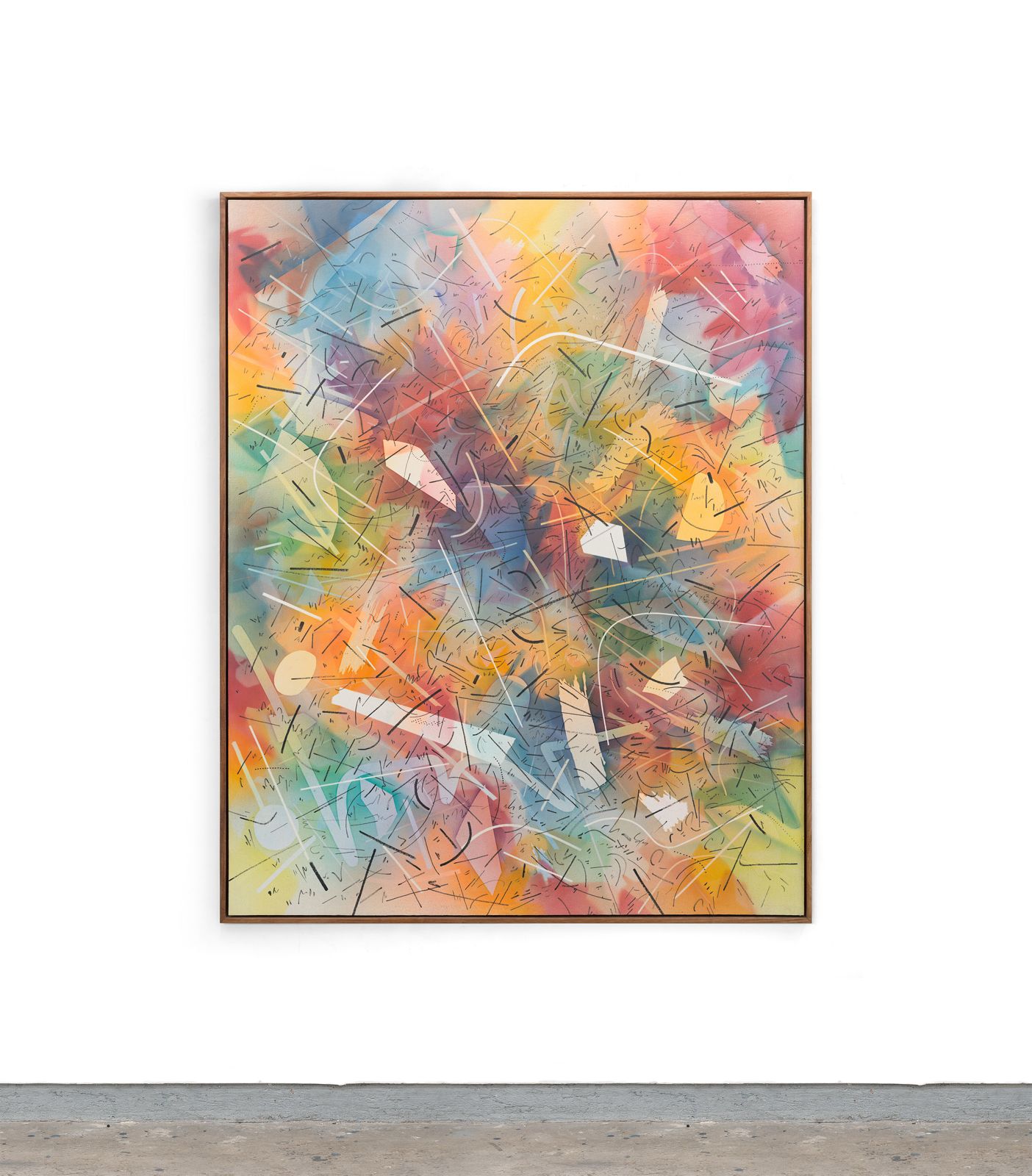
Galleria Macca is proud to present The way we are, Omar Rodríguez-Graham’s third solo presentation, curated by Efisio Carbone. The exhibition will be available exclusively online through our website and social media channels until the 26th November, 2026. Throughout the exhibition, a series of short reels will be released in which the artist and curator introduce the artist’s work and the monographic catalogue published by Fondazione MACC in 2025.
The Painter of Light
Capturing light seems to be the starting point of Omar Rodríguez-Graham’s work. Not simply to portray it or use it to give shape to space, but to follow it as it meets matter and transforms it. It is an age-old, almost impossible pursuit. Light can never truly be captured; it changes even as we look at it.
In Rodríguez-Graham’s works, light doesn’t seem to come from outside, neatly arranged and predictable. Instead, it appears to emerge from within the painting itself, slipping between layers, overlapping brushstrokes and dense patches of colour. At times, it comes through strongly; at others, it remains hidden beneath the surface, like an ember that is still glowing. Colour is no longer just decorative. It becomes something alive: spreading, pulling back and pushing against the colours around it.
Although separated by centuries, this approach brings to mind Piero della Francesca, for whom light was a quiet, steady presence, giving the world a sense of order and permanence. Rodríguez-Graham, however, turns this idea on its head. Where Piero created a clear and carefully balanced space, he lets light move through a more uncertain world of fragments, tensions and sudden openings. Light still gives shape to the painting, but it no longer guarantees order. Instead, it challenges the very forms it helps to create.
[…] His work also connects with the energy of the Futurists, especially where light stops being a way of creating atmosphere and becomes movement. In Umberto Boccioni’s works, matter seems to twist under the pressure of space; in Giacomo Balla’s, rays of light break apart, multiply and fall into rhythm. Rodríguez-Graham shares this sense of movement, but without the Futurists’ fascination with speed. His movement is more inward, almost geological: the image pulses and trembles, as if struggling to come into view.
[…] This is a physical, restless light. It cuts into matter, opens up cracks and brings out images that seem ready to disappear. It offers no answers and leaves the viewer unsettled. Instead, it draws us towards the fragile point where painting comes to life: somewhere between what we finally manage to see and what, in that very same moment, begins to disappear again.
(Efisio Carbone, ISRE Sardegna)