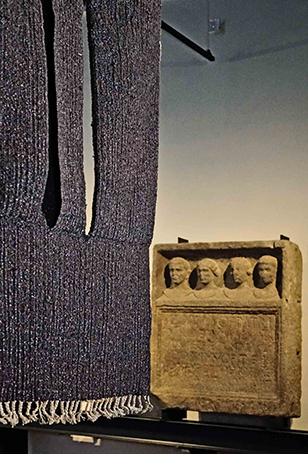
To mark the tenth anniversary of the death of the artist Sandra Marconato (Padua, 1927–2016), one of the most significant figures in textile and material-based research in Italian art of the second half of the twentieth century, the Civic Museums of Padua, with the support of the Fondazione Cassa di Risparmio di Padova e Rovigo, present an installation of tapestries at the Archaeological Museum of the Eremitani Museums, curated by Stefano Annibaletto and Francesca Veronese.
Following her early years in Venice, where, still very young, she worked at the loom with Anna Akerdahl, and her encounter with Carlo Scarpa, Marconato’s practice developed along a path that brought together technical rigour and a strong sense of design. On the one hand, a discipline attentive to structure and rhythm; on the other, a sensibility attuned to the effects of light and colour, partly shaped by her experience with Scarpa’s glass. Over time, this approach helped to move textile art beyond the boundaries of craftsmanship, placing it within a contemporary context and earning recognition in international settings, including the Venice Biennale.
A central aspect of her practice lies in her use of materials: wool, gauze, paper and cellulose. These are simple elements which the artist transforms into light, layered surfaces, characterised by subtle variations and a delicate balance between tension and transparency.
The installation at the Archaeological Museum continues a dialogue between contemporary art and ancient artefacts that the museum has explored on previous occasions. Here, a selection of tapestries made in the 1970s—among the most representative works of her practice—is suspended above three Roman mosaics. The works hover without ever coming into direct contact with the ancient floors, creating a visual encounter founded on distance and superimposition.
The title of the exhibition evokes the Oracle of Delphi and alludes to a gradual process: something slowly taking shape, like a movement emerging from below. The image finds its counterpart in the tapestries themselves, suspended above the mosaics as though rising from an ancient floor.
Austere, still and silent, the works do not present themselves as completed forms, but as apparitions, as thresholds where material presence seems to grow ever more tenuous, allowing something to emerge that never quite permits itself to be fully grasped.
In this lightness, in this continual movement of emergence and retreat, perhaps lies the highest and most secret dimension of the artist’s practice.