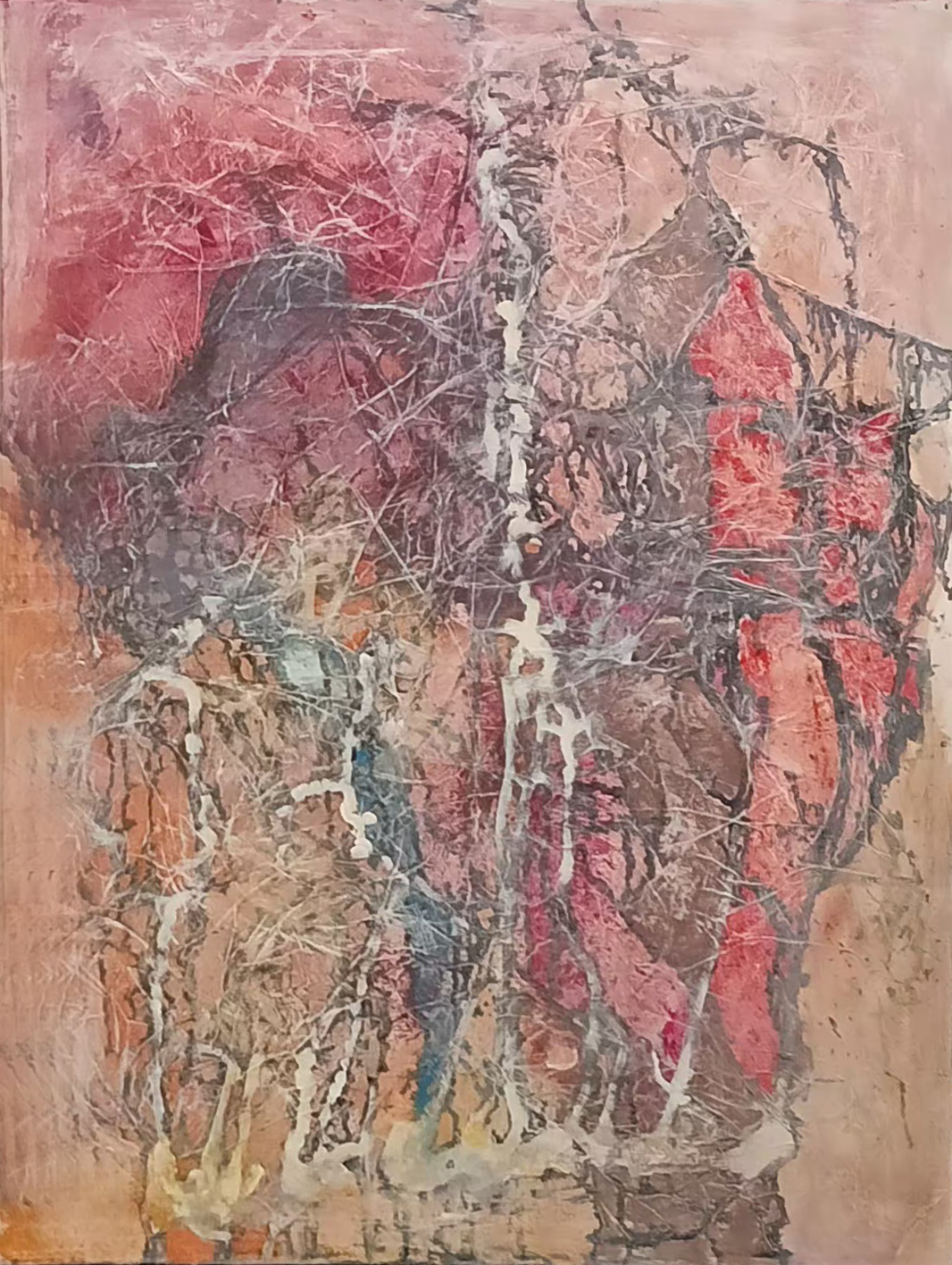
Sincresis presents Geographies of the Invisible, a solo exhibition by Cecilia Chiavistelli, whose work is rooted in a pictorial investigation of the relationship between mark, matter, landscape, memory, and individual experience. The project develops around the idea that every place possesses a hidden dimension that cannot be reduced to the coordinates of conventional geography, but emerges through perception, memory, and the act of painting.
In the artist’s practice, marks construct territories that resist any single definition. Interweavings, superimpositions, accumulations, and swirling masses of matter generate surfaces that evoke maps, organic patterns, pathways, and layers of sedimentation. Painting proceeds through accumulation and stratification, as if each gesture preserved the memory of those that came before. The territory is thus reconstructed through chromatic matter capable of conveying not so much its visible appearance as its complexity and invisible depth.
The works suggest that every place is traversed by traces, presences, and memories that cannot be fixed through geographical coordinates. Painting becomes a means of bringing to the surface what belongs to a deeper dimension of experience: the memory of a place, the perception of time, the sensations associated with moving through it, and the transformations it produces in those who inhabit it.
The title Geographies of the Invisible emerges precisely from this tension. While traditional geography identifies, measures, and delineates, the geography evoked by Chiavistelli’s painting proceeds through what cannot be measured. The surface becomes a map without a legend, inviting the eye to venture into it and follow unpredictable paths formed by mark, colour, and matter.
The geographical dimension is also connected to the artist’s biography and her relationship with travel and with moving through different places. Born in Poggibonsi, Chiavistelli has developed over the years an artistic practice nourished by movement between territories, encounters, and experiences, transforming distance and displacement into opportunities for discovery. The places she encounters do not remain mere coordinates, but become part of a personal geography made up of layers, memories, and new perceptions.
In this process, painting does not represent a landscape but searches for its deeper and more elusive dimension. Gesture becomes memory, matter becomes experience, and the surface becomes a space in which the visible and the invisible can coexist. Chiavistelli’s works invite us to consider territory not as something stable and defined, but as a constantly evolving reality, shaped by the gaze and by the experience of those who move through it.
The exhibition therefore offers a reflection on the possibility of inhabiting places through what is not immediately perceptible, yet can be expressed through painting.