At the Faculty of European Languages and Cultures – Department of Italian Linguistics and Literature at the University of Social Sciences and Humanities – Vietnam National University, Ho Chi Minh City (USSH – VNU-HCM), an educational activity dedicated to contemporary Italian art and its dialogue with Ho Chi Minh City was carried out by lecturers Nguyen Thi Ngoc Hanh, Nguyen Thi Thuong Thao and Cinzia Grieco.
The activity was designed to introduce students to contemporary Italian artistic research through a participatory project focusing on Giuseppe Penone, Grazia Toderi and Arcangelo Sassolino. Following an initial reflection on the meaning of “contemporary”, students were invited to consider the relationship between artwork and space, the use of non-traditional materials, the involvement of the viewer, and the ability of art to engage with contemporary reality.
During the workshop phase, students were divided into groups and asked to imagine that one of the three artists had been invited to Ho Chi Minh City to create a new work inspired by the city. Each group identified a significant element of the urban context and developed an artistic proposal, defining its title, materials, location, meaning and relationship with the public.
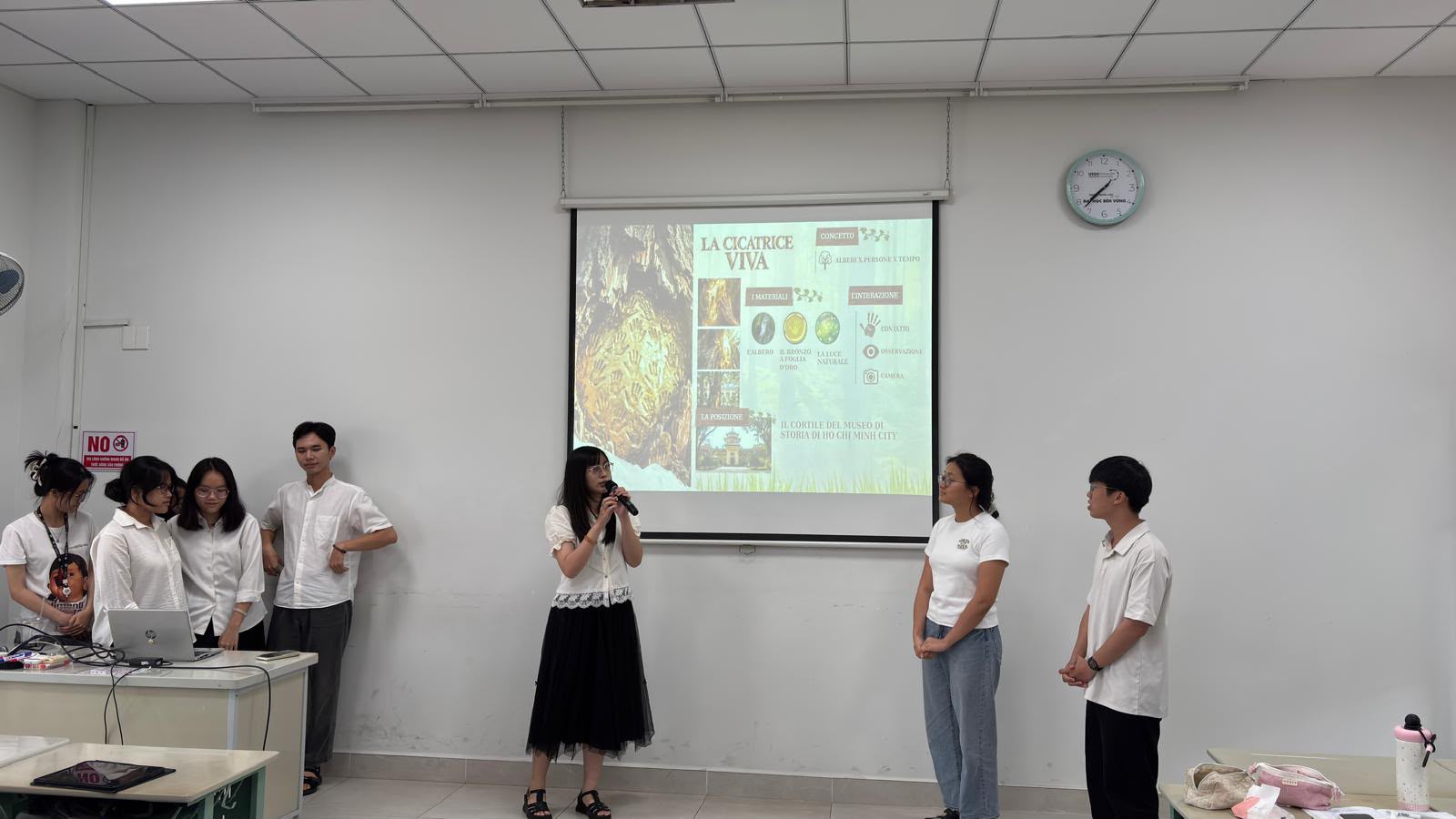
The group working on Giuseppe Penone explored the relationship between nature and urban transformation, focusing on trees and green spaces and imagining a work capable of connecting natural growth with urban development. The group dedicated to Grazia Toderi focused on the nighttime lights of Ho Chi Minh City, its streets, buildings, bridges and urban movement, using these elements as the starting point for an installation devoted to the perception of the city through light. The group working on Arcangelo Sassolino investigated the relationship between humans, machines, matter and urban infrastructure, identifying industrial, technological and architectural elements of the city as possible components of a new work.
The final phase was devoted to presenting the projects to the class. Students presented their proposals, explaining their choices and relating them to the artistic research of the three artists.
The activity enabled students to engage with contemporary Italian art through an active and creative approach, moving beyond simple observation. Designing a new artwork required them to interpret different artistic languages, observe their own environment and transform significant elements of it into an original artistic proposal.
The dialogue between contemporary Italian art and Ho Chi Minh City was particularly significant. Students used the languages of the three artists to observe and reinterpret the urban reality in which they live and study. “Three Views of the City” proposed an approach to contemporary art based on observation, imagination and participation, fostering dialogue between Italy and Vietnam.