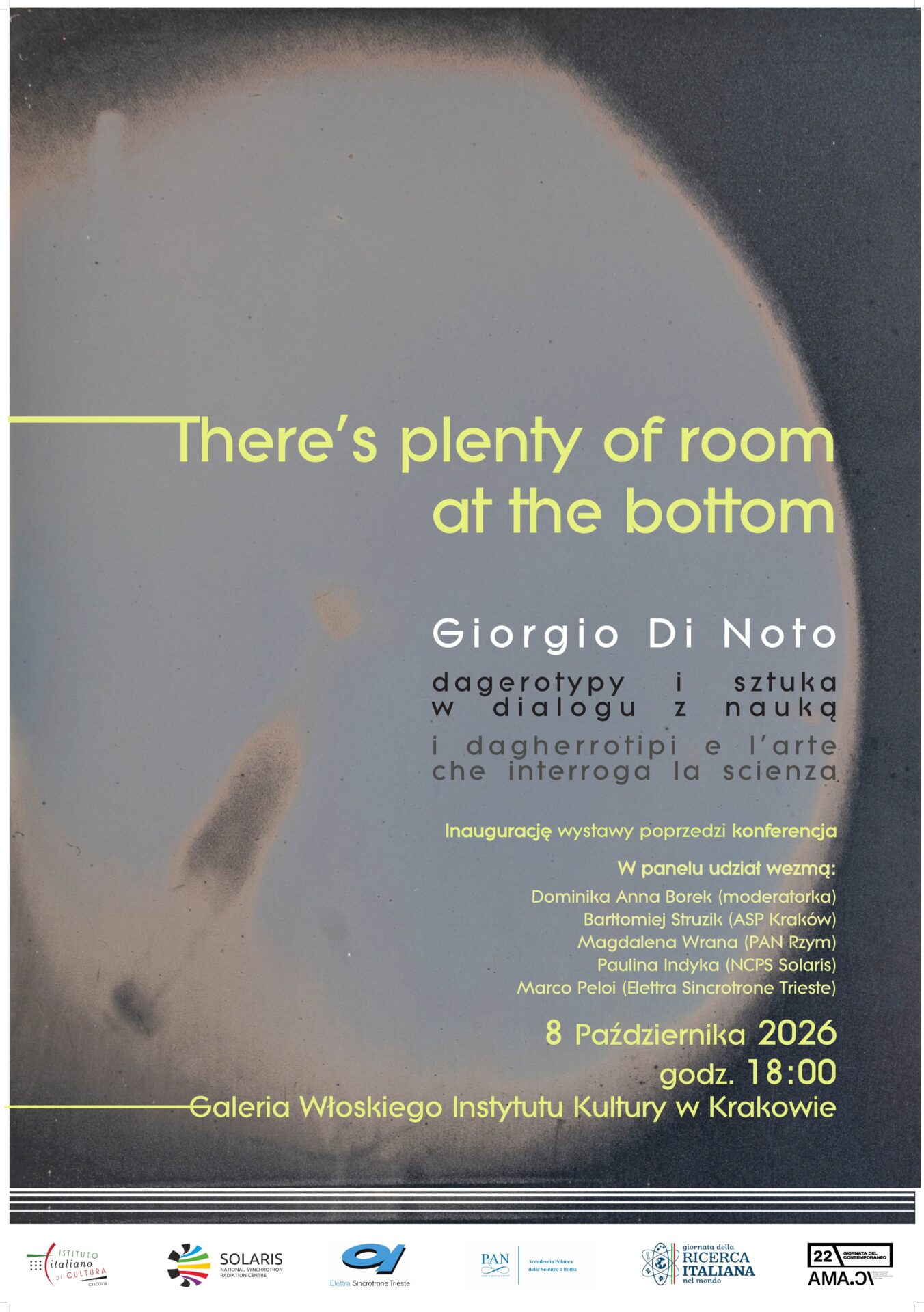
On October 8th at 6:00 PM, the gallery of the Italian Institute of Culture in Kraków opens There’s Plenty of Room at the Bottom, an exhibition by Giorgio Di Noto. The opening will be preceded by a conference with Italian and Polish scholars and artists, dedicated to the relationship between science and art, the use of the artistic medium in promoting science, and the different yet comparable characteristics of the scientific method and the artistic method in the investigation of reality.
The title comes from a lecture given by Richard Feynman in 1959 at the American Physical Society, considered the first scientific reference to the potential of nanotechnology. The question he posed was: what would happen if we could arrange atoms one by one as we pleased? Giorgio Di Noto starts from the little-known fact that the daguerreotype, the first photographic process in history, is now recognized as one of the earliest, entirely unwitting, examples of nanotechnology. The definition and optical qualities of these plates depend on the size of the silver, mercury and gold nanoparticles that form on their surface. These are images that work like mirrors: they reflect the face of the viewer while also showing a photograph that changes appearance depending on the light and the angle of observation.
The exhibition will be opened by a public discussion panel featuring Bartłomiej Struzik (Academy of Fine Arts in Kraków), Magdalena Wrana (Director of the Rome Station of the Polish Academy of Sciences), Paulina Indyka (Solaris Synchrotron Kraków), and Marco Peloi (Elettra Sincrotrone Trieste), moderated by Dominika Anna Borek (Academy of Fine Arts in Tarnów).
The exhibition is organized as part of the Day of Italian Research in the World, promoted by the Italian Ministry of Foreign Affairs and International Cooperation, and of the 22nd Day of Contemporary Art promoted by AMACI. The project’s partners are Elettra Sincrotrone Trieste, the SOLARIS National Synchrotron Radiation Centre in Kraków, and the Polish Academy.
Giorgio Di Noto (Rome, 1990) is an artist and photographer. He trained at the Centro Sperimentale di Fotografia Adams and learned darkroom techniques working with Italian printers; since 2011 his research has focused on the materials and languages of photography, and in particular on the relationship between technical process and image content. The Arab Revolt (2012), a self-published book on images of the Arab uprisings that circulated online, was included in The Photobook: A History Vol. III by Martin Parr and Gerry Badger; in 2013 the British Journal of Photography named him one of its “Ones to Watch”.