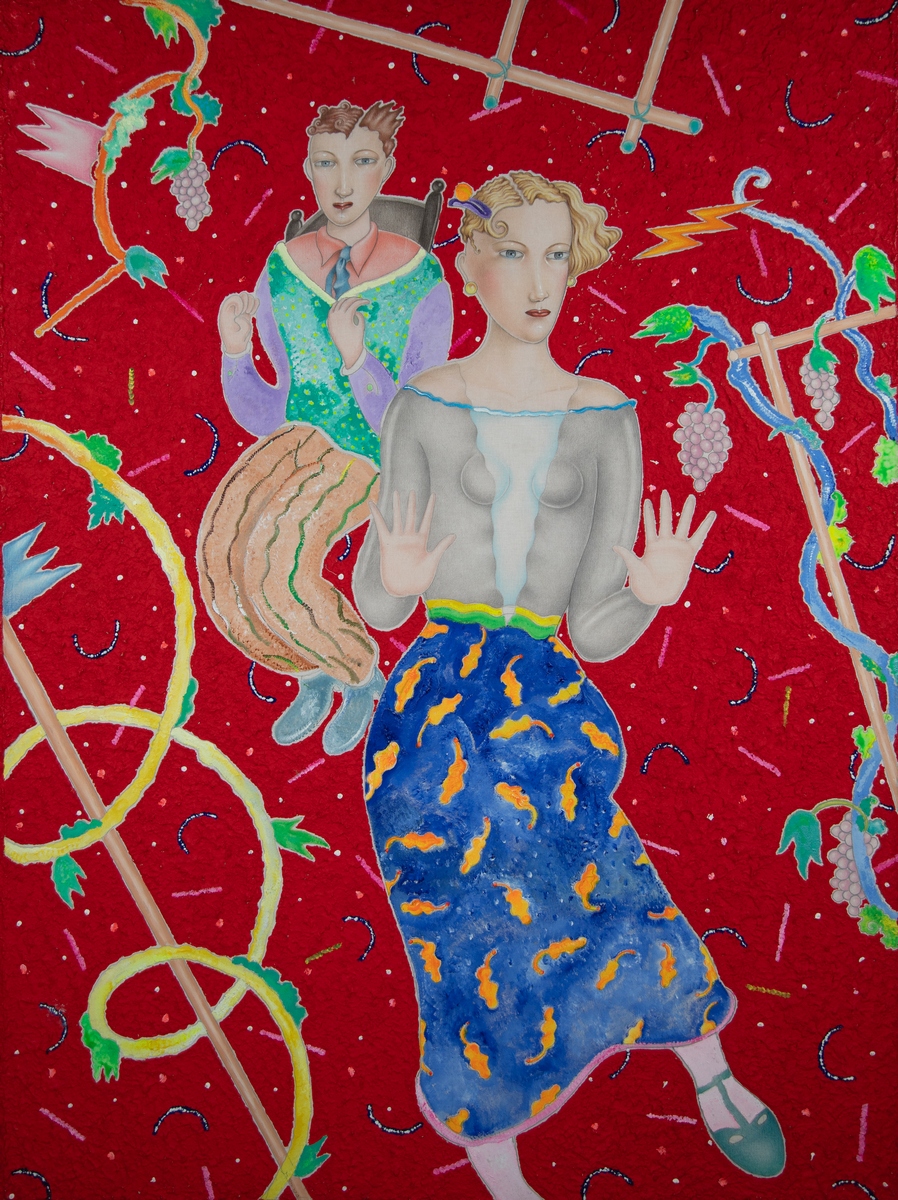
Bonioni Arte Gallery in Reggio Emilia (Corso Garibaldi 43) presents Visionary Landscapes by Luca Alinari (Florence, 1943–2019), one of the leading figures on the Italian art scene in the second half of the twentieth century.
The exhibition is organized in collaboration with the Luca Alinari Archive, directed by Filippo Alinari with the collaboration of Cristiano Ragni.
Alinari’s figurative universe, populated by imaginary landscapes, architecture, animals, and enigmatic figures, reveals an ongoing reflection on humanity and society. References to everyday reality and autobiographical elements, transformed by the artist into a visionary dimension, reflect his conception of painting as a space for exploration and freedom.
The exhibition features around twenty paintings on canvas, produced mainly from the 1990s onwards, alongside a number of significant works from the 1970s.
“Luca Alinari is an important figure in the history of twentieth-century Italian art,” says gallerist Federico Bonioni, “and deserves greater recognition than he currently receives from the art market. Through this exhibition, we aim to highlight his work and artistic journey by presenting a selection of paintings that will also be included in the forthcoming catalogue raisonné.”
The exhibition pays tribute to Luca Alinari and to an artistic practice that, over more than fifty years, continuously explored different languages, techniques, and artistic periods while preserving its distinctive identity.
Luca Alinari (Florence, 1943–2019) was a self-taught artist who made his debut in 1968 with a solo exhibition at Galleria Inquadrature in Florence. During the 1970s, he developed an artistic practice based on juxtaposing figures and objects within suspended, dreamlike settings, engaging with Neo-Dada and Pop Art. He experimented with decalcomania, collage, and photographic transfer, developing a form of painting based on the combination of different techniques and imagery.
Introduced by Alfonso Gatto, Alinari exhibited at leading Florentine galleries and associated with writers including Domenico Rea, Edoardo Sanguineti, Goffredo Parise, and José Saramago. In 1982, he participated in the Venice Biennale, followed by the Rome Quadriennale in 1986. In 1990, he created the Cencio, the painted banner awarded to the winner of the Palio di Siena. In 1993, Palazzo Reale in Milan hosted a retrospective exhibition of his work. In 1999, his self-portrait was acquired by the Uffizi Galleries. In 2018, he received the Gonfalone d’Argento, the highest distinction awarded by the Region of Tuscany.
His artistic research continued until the final years of his life, developing a distinctive repertoire of landscapes, figures, and forms rooted in the realm of the imagination.