What remains is the threat.
In times of crisis, the residues of violence are not erased, they are domesticated.
We live among the remnants, not as survivors but as archivists of unspoken catastrophes.
These pieces suggest that violence does not always arrive as rupture or explosion. It operates through form, surface and repetition. It is encoded in the everyday: in walls, clothing, rituals and representations. What these sculptures lay bare is that violence, far from being a singular act, is an architecture. It is institutional, aesthetic, theological, bureaucratic.
The three silver-plated bronze reliefs embedded in printer paper trays depict medieval scenes of devouring. Once carved as public warnings, they are presented here not as superstitious relics but as primitive blueprints of moral control. The devouring mouth becomes an administrative tool, a visual mechanism of inclusion and exclusion. It does not punish deviant bodies, it processes them. The monstrous becomes procedural. This reflects the evolution of violence, from dramatic punishment to systematic processing.
The Dibond structures, folded with geometric precision, do not imitate architecture, they echo it. Their cold, industrial surfaces conceal histories while revealing none, silences sealed into metal rather than exposed as ruins. This apparent metallic endoskeleton operates as a scaffold, bearing the leather jackets and organizing the traces they carry. Draped over it, the jackets are relics, empty skins no longer worn but exhibited. A molt is not a memory, it is a trace without a subject. A gesture of life now inert.
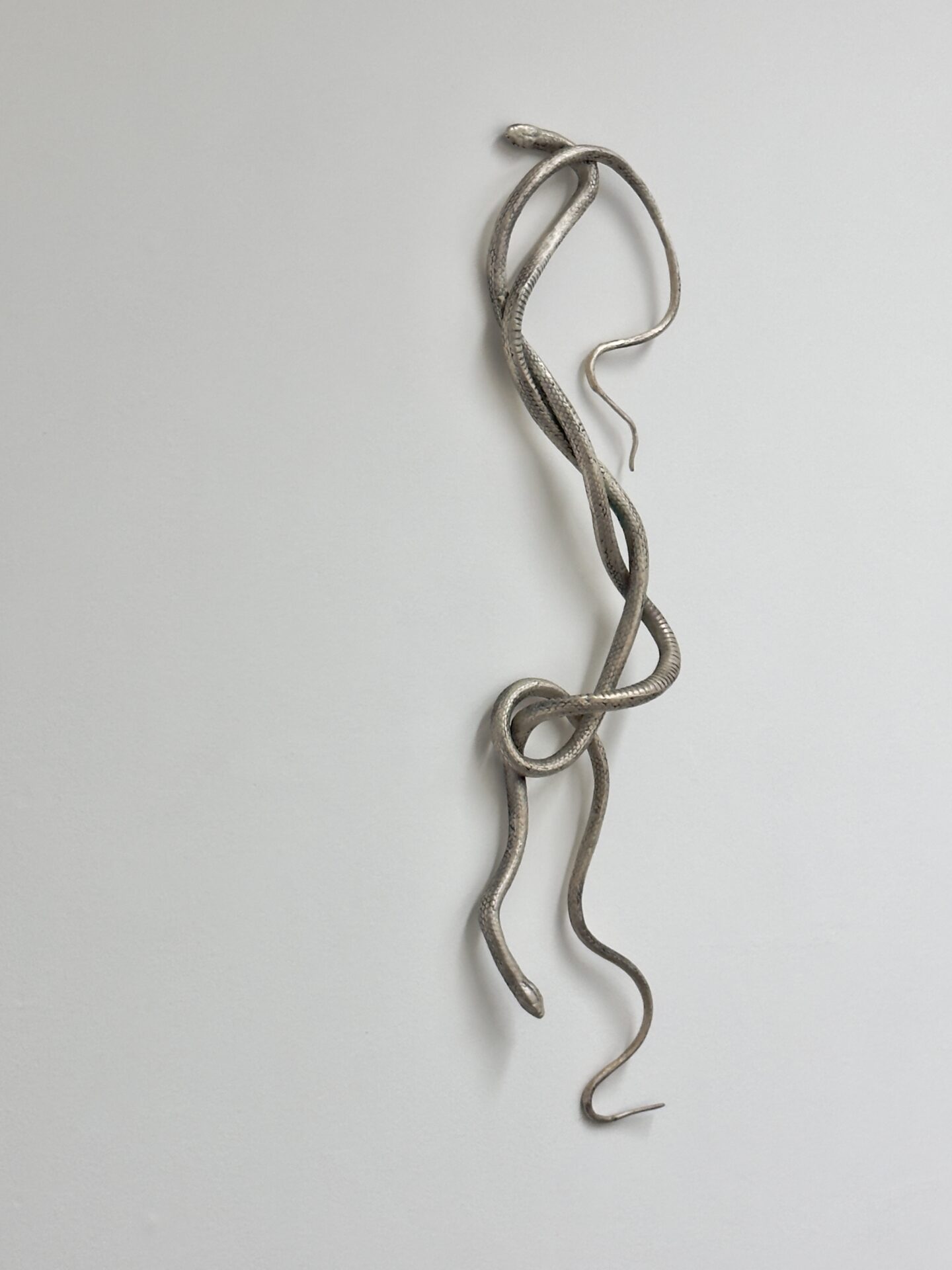
From within these folds, serpents emerge, silver-plated, totemic. They do not bite, they linger and embody a deep paralyzing anxiety, internalized and unresolved. They do not symbolize fear but structure it. They are not metaphors for danger but incarnations of a threat that is both ambient and inevitable. A psychological pressure born of systems that deny their own harm.
Each piece is a deposition in metal, leather and bronze, not of what was done but of what was allowed. What was tolerated, normalized and integrated into the structures of daily life. These works are not interpretations but material outcomes of a world that embeds violence into its very operations, turning trauma into surface, into system, into form.
There is no resolution here because violence has no end. It persists. It circulates. These are not artworks but fragments of architecture, belief and flesh, torn from their original use. They bear witness to both what has disappeared and what continues to haunt the present.
They repair nothing. They endure, not as symbols but as strata, evidence that violence was never an event but a structure. And that structure is still here.
Bojan Šarčević – What remains is the threat
Contemporary art exhibition at Pinksummer, Palazzo Ducale.
Mostra
When
10/10/2026
15:00 - 19:30
Where
Piazza Giacomo Matteotti 28R, Palazzo Ducale, Cortile Maggiore, 16123 Genoa (Genoa)
Admission
Other nearby events
see all
Altro
Online
VIVA. For a present public art – III
When: 10/10/2026
09:30 - 18:00
Where:
Online
45 years after the death of Guido Micheletti, Matteo Lenuzza and Valentina Cervella present a public art project between intermittent traces and historical memory
Studio visit
Lerici
INFINITE ART
When: 10/10/2026
09:00 - 20:00
Where:
Leona K.
Exhibition and performance event featuring a Live Painting Workshop
Studio visit
Bordighera
OPEN STUDIO
When: 10/10/2026
10:00 - 12:30
/
15:00 - 17:00
Where:
Bordighera
Davide Puma opens his studio
Laboratorio
Genova
Segni di Calma
When: 10/10/2026
11:30 - 13:00
/
14:30 - 18:30
Where:
Silvia Dalla Dea