Sedimentation is an action of time.
It is the slow deposit of what has crossed a space, a matter, an existence. It is movement that makes a trace, a transformation that finds a form without completely stopping flowing.
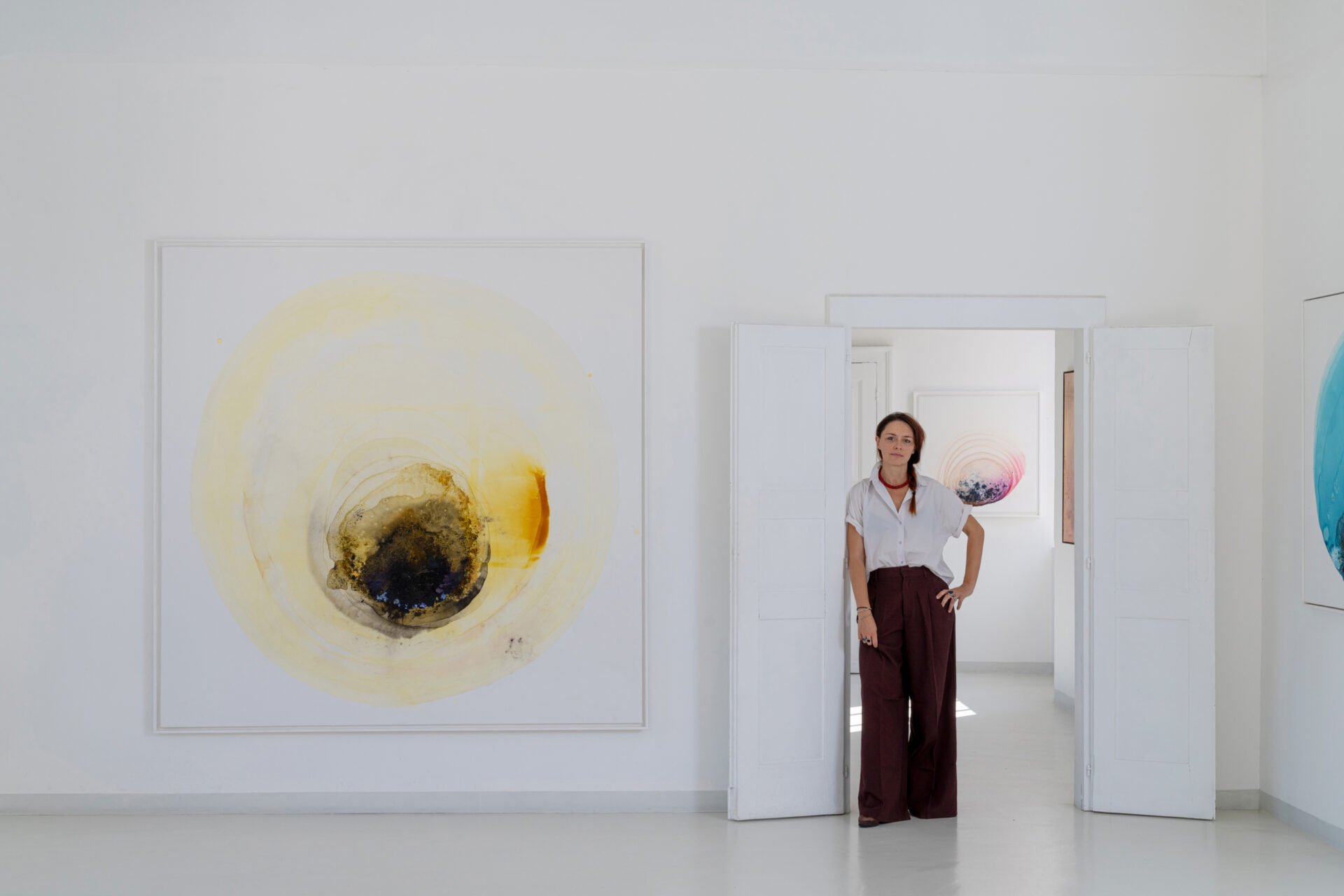
In Ilaria Franza’s painting this process becomes gesture and, at the same time, expectation. The artist intervenes on the subject, guides it, accompanies its course, but does not completely determine its outcome.
Water and color have their own will: they flow, meet, retreat, penetrate the surface, thicken. The human gesture starts a
Process that nature continues.
Sediment/azioni was born in this border territory, where action and abandonment coexist. In sedimentation there is already an action: slow, silent, entrusted to time. An almost imperceptible process, through which time changes matter and matter makes time visible.
Ecoline, inks and liquid acrylics move on the surface following only partially predictable trajectories. The pigment is driven and left free, held and released. What remains is the memory of this passage: margins, veils, densities, transparencies, overlaps.
Each work preserves the story of its own happening.
However, it is not just a physical process. Sedimentation also belongs to experience. We live accumulating traces: images, meetings, absences, places, changes. Some remain on the surface, others slowly descend towards a depth that we cannot observe directly, but that continues to transform us.
Franza’s landscapes seem to emerge from this very depth. They do not describe a precise place, yet they preserve something of nature: the horizon, the water, the light, a distance.
They are inner landscapes, territories suspended between what appears and what
It surfaces to the memory.
Water crosses all research as matter and as a metaphor.
It is what carries and what deposits. Erase, dilutes, unites, separates.
It does not have its own form and for this reason it can contain infinite.
Painting is entrusted with a similar task: to welcome what passes without immobilizing it.
In Sediment/actions, each surface thus becomes the temporary place of an encounter: between will and chance, control and abandonment, permanence and transformation.
Because perhaps what we are is not only what we go through, but what, crossing us, sediments.