ANOTHER GREEN WORLD
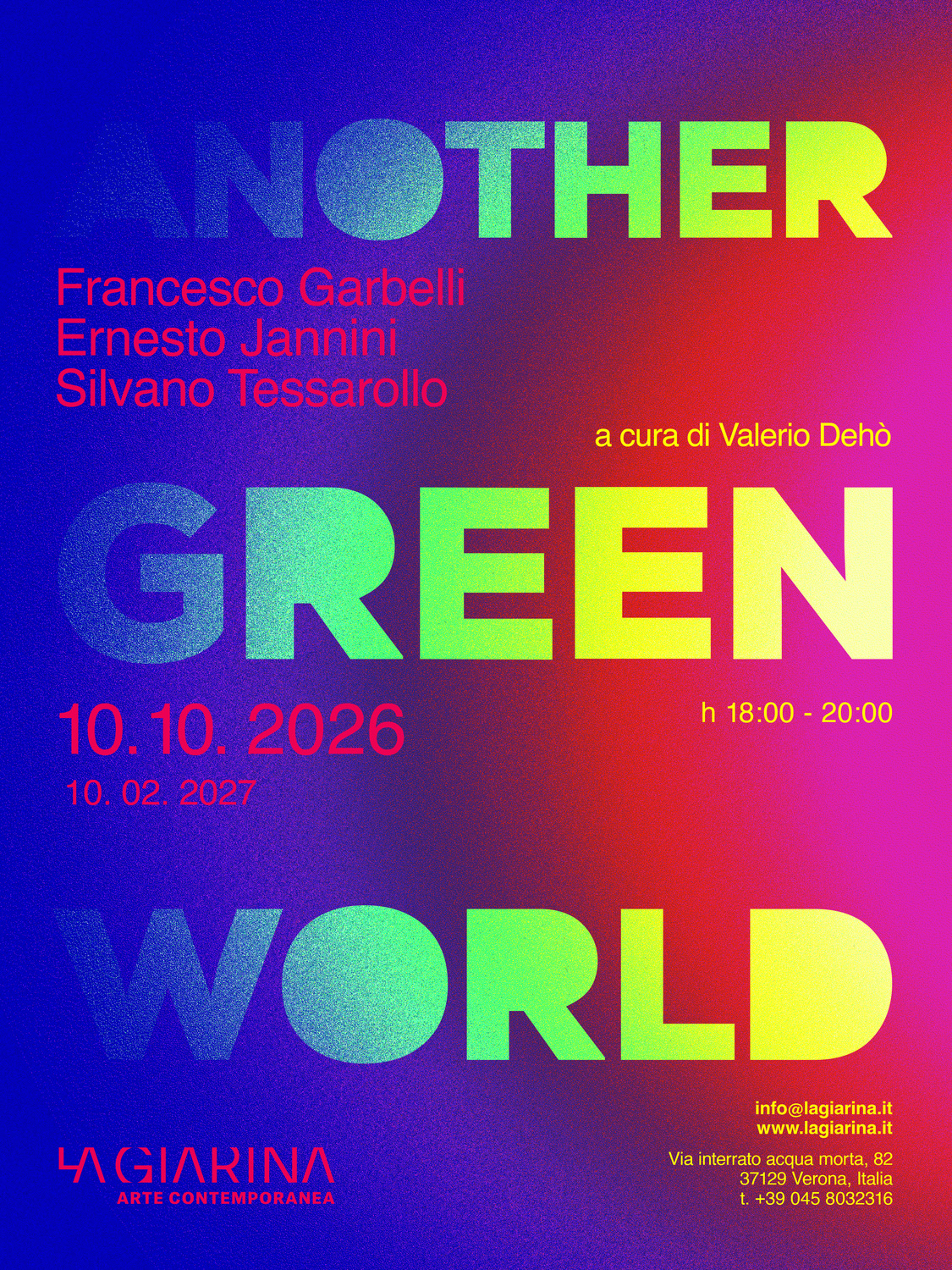
Francesco Garbelli, Ernesto Jannini, Silvano Tessarollo
Curated by Valerio Dehò
La Giarina Arte Contemporanea – Via Interrato Acqua morta 82, 37129 Verona
Opening Saturday 10th October 6-8 pm
Is it possible to speak of “green” without becoming embroiled in the controversies and ideologies that have almost become religions? How should Art, which remains a superstructure – not only in Marxist terms – address these issues? What happens when artists’ individual languages intersect with factual reality, and in particular with the prevailing dystopian vision?
Perhaps some answers can be found precisely in an approach to artistic expression that retraces the lines of representation, the deviation from classical mimesis, and refuses to accept that aesthetic practice should serve a useless and empty ideology. Behavioural and relational art place the obvious on stage as though it were a discovery. The aim is to raise the public’s awareness of something it already knows through the media. Global warming, floods, or the large-scale recurrence of El Niño are things we read about and see every day. What more can the choices of an artist, or its simulations of a reality that daily surpasses the imagination of people seeking their own position in the world, actually offer me? Something similar has already happened with migrants, to whom biennials were devoted, prompting the art milieu to shed crocodile tears over deaths at sea and violence – only for the subject to fall out of fashion once the trend had passed, and thus no longer serve a purpose. When art ceases to merely represent and to become confused with reality – as though reality needed it to do so – it becomes more effective. It does what it is meant to do: leave behind iconic messages that sink their roots into time, and not merely into space.
The title Another Green World is taken from an album by Brian Eno released in 1975. The underlying idea of the exhibition is certainly nature, the green spirit, the backdrop of everyday tragedies, and their interpretation from the perspective of art and culture. Not a wild or unrelated nature, but one reconstructed through art, which recreates its distinctive characteristics in a metaphorical and independent synthesis. Not so much an immersion as a complicit gaze that nonetheless remains a point of observation from which the artists look at the contemporary world. Then there is the symbolic dimension of this perspective: an opening towards horizons of meaning that are not solely connected to the current emergency, but also to a vision of individual transformation and intellectual participation, raised to a symbolic plane that is not consumed by the present. Why does Giorgione’s The Tempest continue to tell us something? What is its time – yesterday, today, or perhaps always?