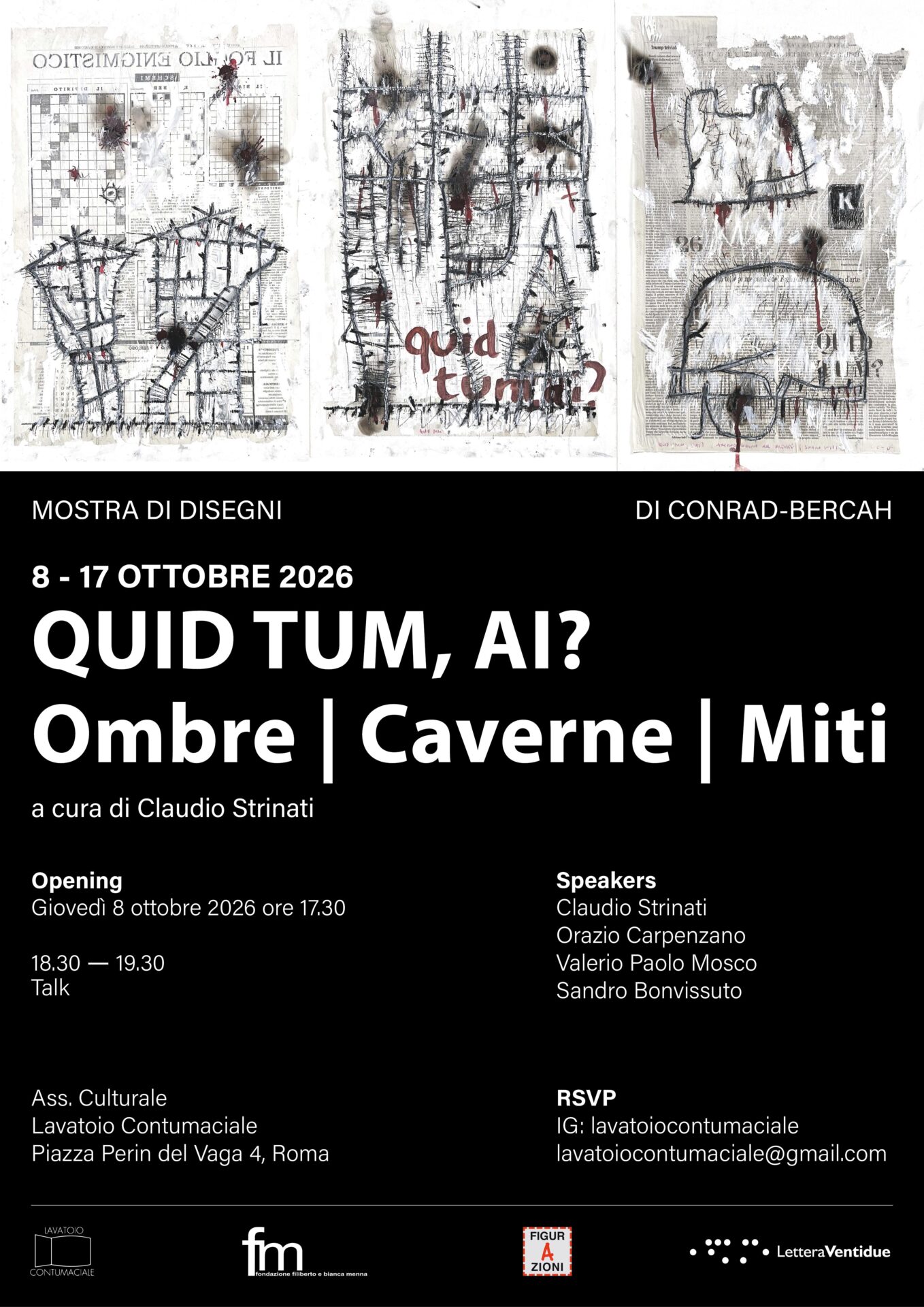
Quid Tum, AI? brings together a corpus of 36 works produced in 2026 by conrad-bercah which, taken as a whole, pose the following direct question to so-called artificial intelligence: Quid Tum, AI? — which could be translated as: So now what do we do?
In a scenario in which the digital revolution is eliminating, at supersonic speed, any notion of dissent or free discussion, before the option of free will — the capacity of a person to autonomously determine their own thoughts and actions — is erased by a Silicon Valley approaching its expiry date, conrad-bercah, struck by a Proustian short circuit, felt the spontaneous need to reread Plato’s allegory of the cave through ‘primitive’ graphic signs drawn across the pages of Il Foglio Quotidiano AI, the world’s first newspaper written by artificial intelligence, an experiment that has attracted the attention of the entire planet.
The operation planted in the artist’s mind the doubt that, whether we like it or not, the inhabitants of the planet are finding themselves reliving an extraordinary Nachleben of the allegory of the cave: a posthumous re-edition of a myth that many would rather leave behind. In other words, the 36 works seem to suggest that today’s population inhabits a space similar to Plato’s cave. A condition for which the population itself appears genetically unprepared: being ‘enslaved’ by applications engineered to generate dependence on a single activity — observing, on the wall, the shadows cast by the new statuettes and the new objects that diligent (read: excessively zealous) attendants (or artificial intelligence applications) carry behind the low wall to which we are chained without being aware of it.
Many seem to believe that those shadows are the only reality that exists. In several cases, they even seem to believe that they are the only shadows that have ever existed. Hence the necessity of the exhibition as a special edition of a newspaper — featuring a different kind of AI.
The exhibition catalogue is published by LetteraVentidue Edizioni, Syracuse.