Museum XXI presents Museums at the “Post-Digital” Turn. Curated by Lorenzo Giusti and Nicola Ricciardi
International conference, 3–4 November 2017, OGR Torino
Over the past decade, connections between networks and digital reality have become effective elements of everyday life. These dimensions have become naturalised in our way of thinking about existence, forming a worldview that encompasses the whole of contemporary living, from our relationship with objects to the branching structure of social dynamics. Art and its system have absorbed this shift – the so-called “post-digital turn” – setting in motion a process of substantial transformation. The real-time sharing of images and information through digital devices has led to an increasing radicalisation of artistic practice, undermining the concept of uniqueness in favour of a principle of “interconnection”.
Museums at the “Post-Digital” Turn is an international conference organised by AMACI – the Association of Italian Contemporary Art Museums – and OGR – Officine Grandi Riparazioni, Turin – in 2017, to open up a cross-cutting reflection on contemporary art museums and the radical changes taking place in the ways art is produced and experienced.
Today, the “online” view almost always precedes the actual encounter with the work (and at times replaces it entirely), and an increasing number of artworks are being created specifically to be experienced through a screen. The consequences of this phenomenon of multiplication and dissemination call into question exhibition conventions, the dynamics of mediation, and the rhythms of production and legitimisation of traditional platforms, in favour of more immediate processes. Consensus, now obtainable far more quickly than in the past, seems to be less and less the expression of considered judgement, and increasingly a collective matter of visibility – of an image’s survival within the web. This online sphere, in relation to the ongoing process of integration between physical and digital space, is increasingly emerging as a material place: not a virtual zone, an alternative to reality, but something concrete that permeates our everyday lives. It is therefore unsurprising that the incursion of digital networks into the various stages of the production and reception of artworks is not giving rise to a new phase in the process of dematerialisation begun by the neo-avant-gardes, but rather to a reinterpretation of realist and materialist thought – on the part of artists, critics and curators – as an alternative to postmodernist and post-structuralist approaches.
Within this frame of reference, the conference raised a number of fundamental questions: What does the future hold for the museum? What role can the museum play, as an institution, in the physical–web space? What changes are under way in curatorial practices, exhibition strategies, collecting and conservation policies, mediation techniques and teaching systems? How has the relationship with the public changed, and how much further will it continue to change in the years ahead? What outcomes – in terms of consensus, impact, and the persuasive and critical capacity of museum projects – is it reasonable to expect from an increasingly “outsourced” system of reception and validation? What role might art history play in the years to come, and how will it engage with the increasingly fluid action of museums?
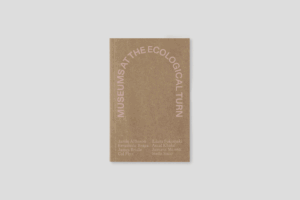
The conference proceedings were published in the volume Museums at the Post-Digital Turn, published by Mousse Publishing in 2019.
The conference was held under the patronage of the Representation in Italy of the European Commission, the Italian Ministry of Cultural Heritage and Activities and Tourism, ICOM Italia, the Piedmont Region and the City of Turin.