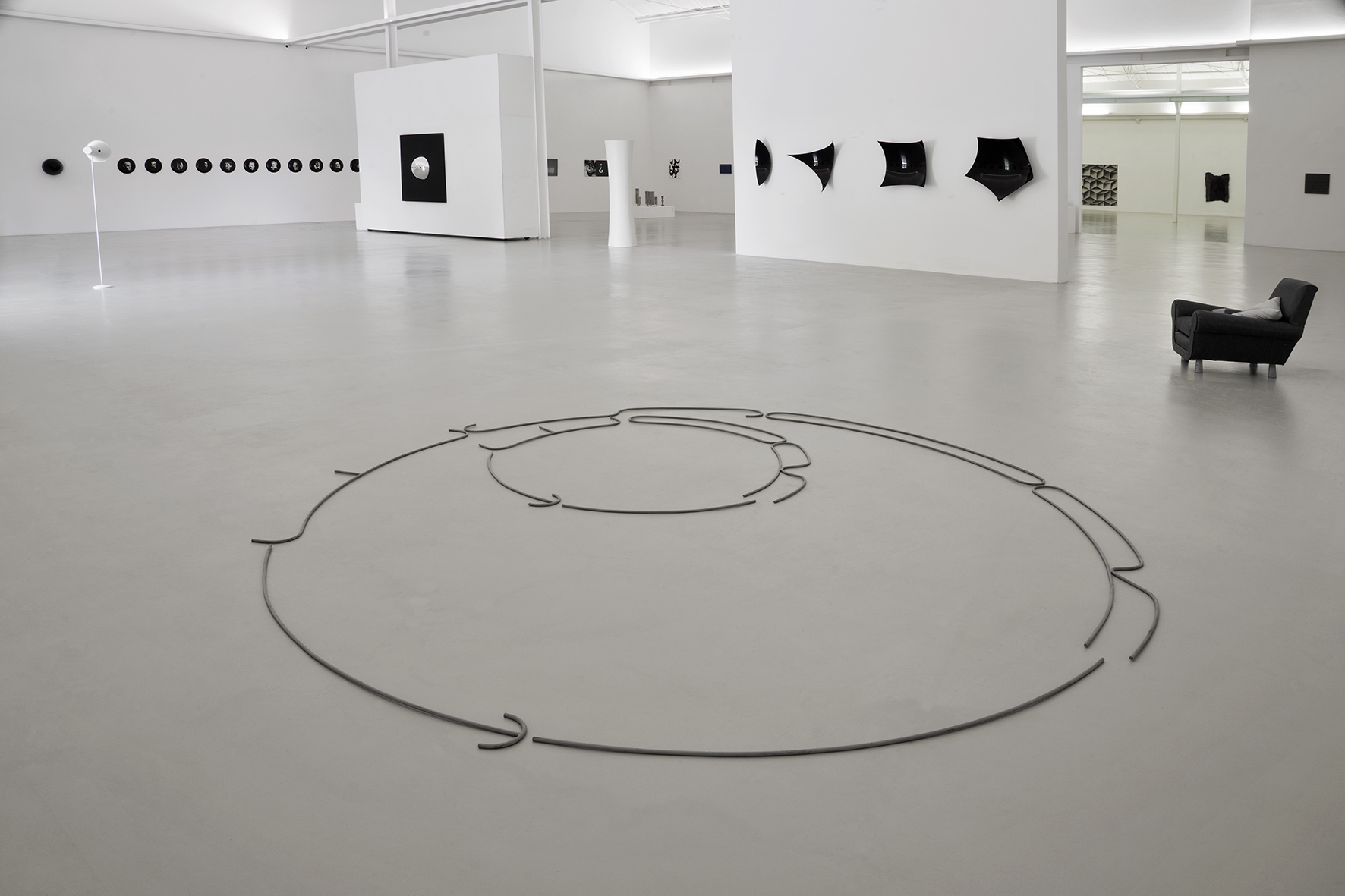
A singular exponent of the generation that emerged in Umbria at the Academy of Fine Arts in Perugia in the early 1980s, among the students of the painter Nuvolo (Giorgio Ascani)—a master whose centenary of birth is currently being celebrated in his native Città di Castello—Karpuseeler immediately stood out among the emerging talents of that era for his rational and conceptual, rather than emotional, approach to art. Like other Conceptual Art movements, Karpseeler’s work initially focused on its own code, researching teleprinter punched tapes, identifying errors, and then moving on to identify words containing concepts that were difficult to represent. His studies of the philosophy of language (Wittgenstein), information theory (John R. Pierce), and cybernetics guided his work toward the use of binary language. Thus were born the first Logical Paintings, 1982, and the first Tautologies, 1982-83. Meanwhile, an interest in aspects concerning acoustics led him to the visualization of sound and the consequent creation of works inspired by it. He created Anoir, Eblanc, Irouge, Uvert, Obleu (1987), the result of the pronouncement of Arthur Rimbaud’s Voyelles, physicalized in turned wood and equipped with convex mirrors on the top of each element, but also other plastic works executed with the same acoustic principle and elaboration method. From the 1980s, it’s worth mentioning a series of other significant works by Karpuseeler, including Sorite è del sorite (Sorite is of the Sorite, 1984), At the Lake (1985), L’Orealtà (The Real Life, 1986), the Komodo Dragon (1987), and My Thoughts Are Back (1987). The 1990s saw the emergence of two new inventions and developments, both conceptual and formal. Preceded by a pair of distinctive examples of a new intuition, the Voice (1989) and the Silence (1990) both made their entry into Karpuseeler’s sculptural repertoire. The Voices, in wood or steel, transcending pictorial two-dimensionality, also stand out for their convex and tapered turning quality that recalls the absolutes of Brancusian form, but, arising from an entirely different origin, they still profess to be generated by Karpuseeler’s interest in acoustics. Dialectically related to the Voices, the Silences, with works similarly defined by plastic forms in fiberglass, wood, or other opaque materials, also emphasizing a verticality that prevails over all other spatial aspects, develop a sublimatory quality. These, and other works such as Triagono, Quadragono, and Pentagono from the second half of the 1990s, conclude the artist’s most significant experiences of the last century, giving space to the topicality of Karpuseeler’s research, among which the Puzzle series stands out, with its d’aprés dedicated to the work of past Masters and certain more recent “Formandi”.
Retrospective Karpuseeler
"Logica ad Arte" a cura di Bruno Corà
Visita guidata
When
10/10/2026
09:00 - 13:00 / 15:00 - 19:00
Where
Via Casilina Nord 1, 03043 Cassino (Frosinone)
Admission
Cortesemente chiamare anticipatamente il numero 3351268238
Website