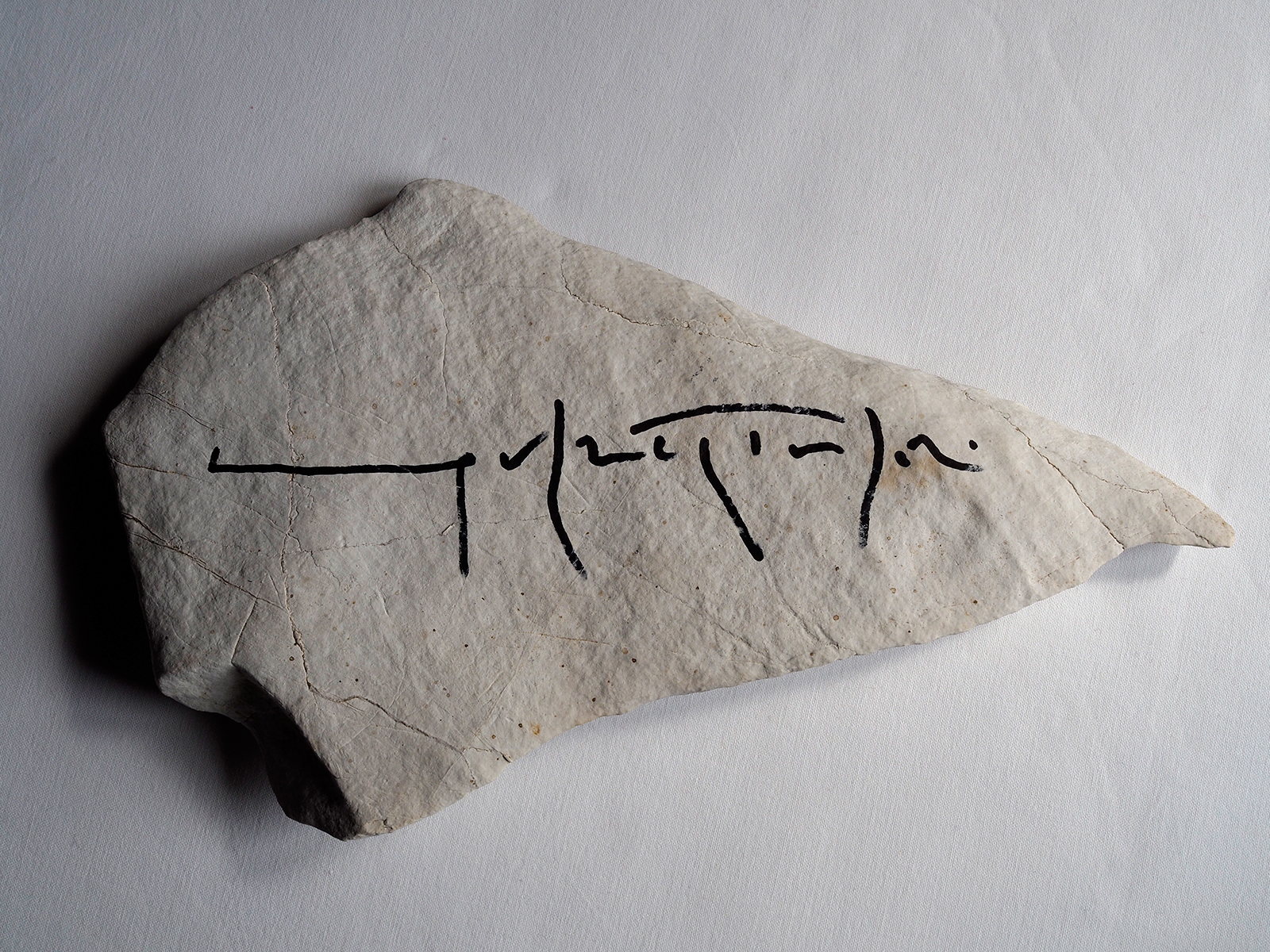
Asemic writing is an artistic practice based on forms of script that appear, at first glance, to be linguistically readable, yet are in fact composed of invented or nonexistent glyphs and signs. It can take shape across a wide range of supports and materials, extending far beyond the traditional sheet of paper.
In Fabrizio M. Rossi’s newest works, writing on stone makes a return, continuing a practice he has explored on several previous occasions. Rocks of different origins, shapes, and dimensions become the ground for a script that is at times minute and densely woven, at others expansive and open, spreading across and occupying the entire space available to it.
Some of these stones come from Leonessa, others from Camaldoli. Each one, however, asserts itself as an independent subject, a distinct individual. They do not seem content to function merely as surfaces for writing. Their texture, proportions, cuts and colours enter into a specific dialogue with the black marks that traverse them.
The stones almost appear as crystallised fragments of discourse: three-dimensional speech bubbles from a form of storytelling that has gradually shed its human voices and, with the passage of time, even the faintest residue of verbal meaning.
Fabrizio M. Rossi: IN ITINERE, II
Asemic writing is an artistic practice