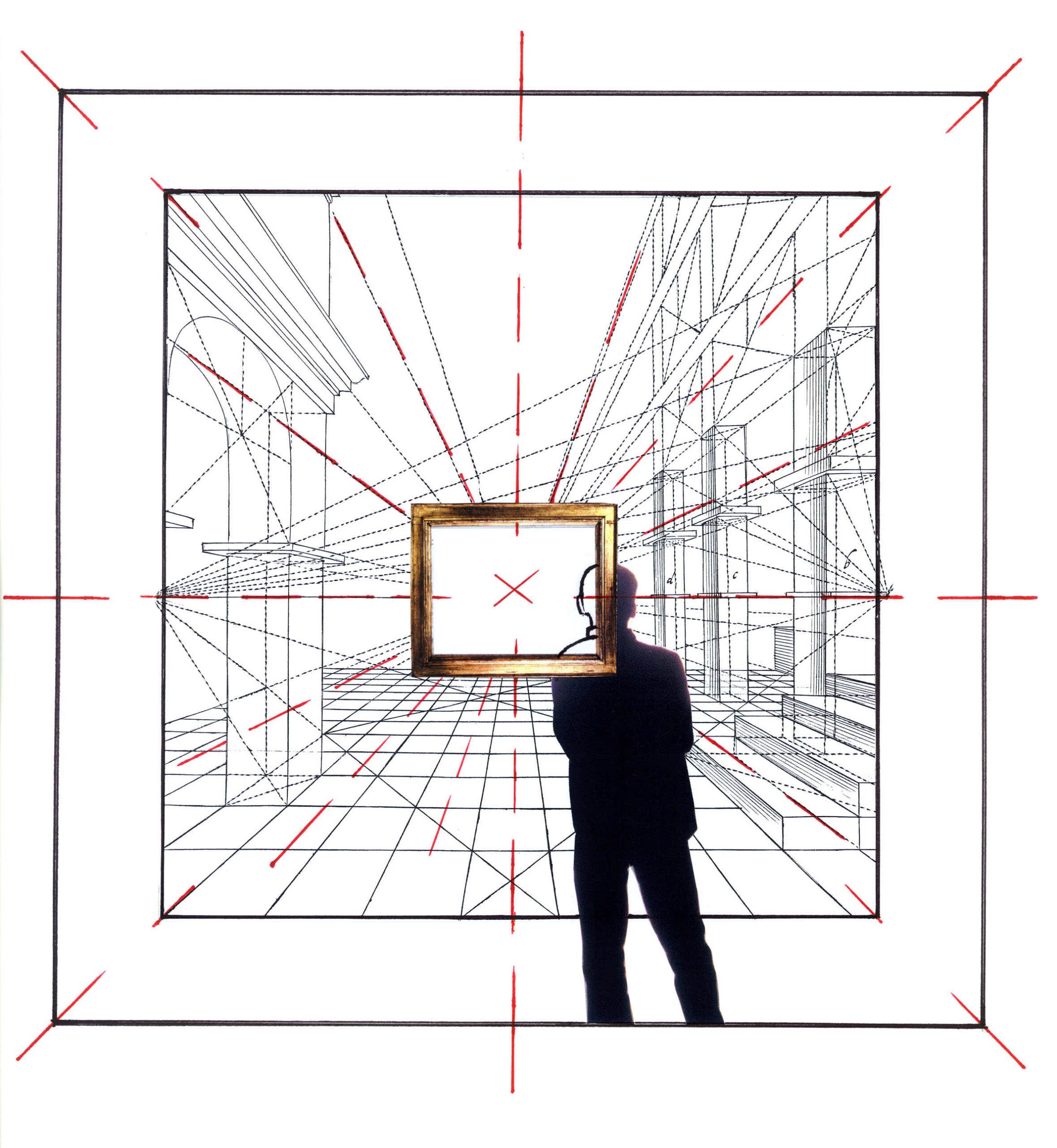
Giulio Paolini is the artist chosen by AMACI, the Association of Italian Contemporary Art Museums, to create the guiding image for the Seventh Edition of the Giornata del Contemporaneo, the major annual event promoted by the Association and dedicated to the art of our time and its public.
Symbolic architecture, a courtly perspective, a golden frame enclosing and highlighting the vanishing point, a figure with his back turned: these are the elements of the work created by Giulio Paolini as the guiding image of the Seventh Day of the Contemporary. Elements that have always been present in his work, which once again bring attention to themes particularly dear to him such as the dimension linked to the perception of the work of art and its museum destination. In a barely noticeable context, the empty gold frame captures our attention, becomes the symbolic as well as the perspective center of the composition and triggers a mechanism customary in Paolini’s work, welcoming part of the viewer’s profile into his space and thereby transforming it into a work. What Paolini proposes is a game of mirrors, a continuous reversal of planes that, with concentric movement, draws our “mobile and precarious” gaze as viewers into the “fixed and immobile” gaze of the painting, reaffirming that the work exists only in the vision of the viewer.
“A picture usually appears to us as a concluded, self-contained image, often highlighted by a frame that emphasizes the material limits of a vision, of a unit separated from the environment where it nevertheless stands. The image sometimes subtends a perspective layout that contributes to the verisimilitude of the scene depicted, and yet separates it even more from the surrounding physical space. Another perspective, this time mental or symbolic, leads to the assumption that other paintings may transpire, coexist in a painting… Do all paintings by one author (all paintings in the History of Art) make one? The works look at us. It is they who look at us and not vice versa. The work does not speak but sees; it sees us at the very moment we think we see it.”
G. Paolini, From Atlas to Void in Alphabetical Order
Thus, the project of entrusting an internationally renowned Italian artist with the creation of the guiding image for the Giornata del Contemporaneo, which in past years has involved Michelangelo Pistoletto in 2006, Maurizio Cattelan in 2007, Paola Pivi in 2008, Luigi Ontani in 2009 and Stefano Arienti in 2010, continues successfully.
Giulio Paolini
Born in Genoa in 1940, Giulio Paolini after living in Bergamo in the early 1950s moved with his family to Turin, where he attended the State Industrial Technical Institute for Graphic and Photographic Arts. From a young age he became interested in art, first frequenting museums and galleries and consulting art periodicals, then, in the late 1950s, experimenting with his first pictorial tests. The discovery of contemporary graphics during his studies and the presence of architectural magazines in his home helped orient him toward a line of research aimed at zeroing in on the image. In 1960 he produced his debut work, Geometric Drawing, consisting of the squaring in ink of the surface of a canvas painted in white tempera. This preliminary gesture of any representation will remain the point of “eternal return” in Paolini’s universe of thought: a topical moment and original instant that reveals the artist to himself, it represents the conceptual foundation of all his future work.
In the early 1960s Paolini developed his research by focusing on the very components of the painting, the painter’s tools and the space of representation. Between 1967 and 1972, critic Germano Celant invited him to participate in exhibitions on Arte Povera, which sanctioned the association of his name with this trend.
In fact, Paolini’s position is clearly distinguished from the vitalistic climate and “existential phenomenology” that distinguishes the propositions of the artists supported by Celant. In fact, Paolini’s position is clearly distinguished from the vitalistic climate and “existential phenomenology” that distinguishes the propositions of the artists supported by Celant. Paolini repeatedly declares his intimate affiliation with art history and programmatically identifies with the collective self of the artists who preceded him.To this intent, foreign to the militant scene of the late 1960s, some of his best-known works should be traced: Young Man Looking at Lorenzo Lotto (1967), the “self-portraits” from Poussin and Rousseau (1968), and the paintings in which he reproduces details of ancient paintings (The Last Painting of Diego Velázquez, 1968; The Study, 1968).The 1970s coincided with his first official recognitions: from exhibitions abroad that inscribed him in the circuit of international avant-garde galleries, to his first museum exhibitions.
In 1970 he participated in the Venice Biennale with the work Elegia (1969), in which he used for the first time a plaster cast of an ancient subject: it was a cast of the eye of Michelangelo’s David with a mirror fragment applied to the pupil. The 1980s constituted the densest period of exhibitions and retrospectives, accompanied by important monographic publications.
In the first half of the decade, an explicitly theatrical dimension began to assert itself, marked by works and installations articulated in space and marked by fragmentation and dispersion, as well as by the introduction of theatrical figures, such as eighteenth-century valets de chambre and other stand-ins for the author, clothing and objects. Pauline poetics is greatly enriched with literary attributes and mythological references; the iconographic repertoire extends to include cosmic images.
In the late 1980s, Paolini’s reflection focuses mainly on the very act of exhibiting. Beginning with the solo exhibition at the Musée des Beaux-Arts in Nantes in 1987, the concept of exhibition progressively takes shape as a “work of the works”: the installations privilege an associative and dialogical vision of the works on display.In the course of the 1990s, the deepening of the idea of exhibition takes on other and new modes: the increasingly complex arrangements often observe an additive typology (seriality, juxtaposition), or centrifugal (dispersion or dissemination from a central core) or centripetal (implosive concentration and superimposition).The exhibition venue becomes the stage par excellence of the “opera house,” i.e.of the work in its making and unmaking: the place that defines the very eventuality of its happening. The work’s completion is, moreover, constantly deferred, leaving the viewer in perpetual expectation: the same expectation that the artist always experiences from afresh at his work table, waiting for the work to manifest itself.
In the 2000s, another theme particularly dear to Paolini acquires particular prominence – as much in his works as in his writings -: the identity of the author, his condition as a spectator, his lack of contact with the work, which always precedes and surpasses him.
As a whole, Paolini’s poetics and artistic practice are connoted as a self-reflexive meditation on the dimension of art, its timeless “classicity” and its perspective without vanishing point.
Through photography, collage, plaster cast and drawing, the intent is always to investigate, with great conceptual rigor, the tautological and at the same time “metaphysical” nature of artistic practice.
Event promoted by
AMACI – Association of Italian Contemporary Art Museums.
With the support of
Ministry of Cultural Heritage and Activities and Tourism – General Directorate for Contemporary Art and Architecture and Urban Peripheries
Bronze Medal of the Senate of the Republic
Under the Patronage of
Representation in Italy of the European Commission
Presidency of the Council of Ministers
Senate of the Republic
Chamber of Deputies
Ministry of Cultural Heritage and Activities
Ministry of Foreign Affairs
Ministry of Youth
Conference of Regions and Autonomous Provinces
UPI – Union of Italian Provinces
ANCI – National Association of Italian Municipalities
ICOM Italy
Main partner
UniCredit Group
Technology Partner
Telecom Italia
Official Partner
Peugeot Automobili Italia SpA
With the contribution of
Terna SpA